
























Joinery
Different Cuts of Oak
Quarter Sawn, Rift Sawn & Plain Sawn
20th December 2023
The look and characteristics of a piece of oak are directly affected by which part of the log it is sourced from. All the oak sourced and produced by Hewins is cut using the through-and-through method, meaning the log is selected for its straightest flank and then sawn from the top to the bottom. The names of the different cuts of oak that can be produced using this method mostly derive from more traditional methods of cutting and converting timber; Crown/Flat Sawn, Rift Sawn and Quarter Sawn.
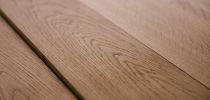
Each type of cut directly influences the grain pattern and therefore contributes to the visual character of the finished piece. The different cuts also affect the dimensions that can be achieved, the stability of the board and the cost of the material.
Oak has veins within the grain pattern that run from the centre of the log, also known as the heart, to its outer perimeter. These are called medullary rays and are sometimes sought after for their attractive striped grain pattern, or equally avoided for a more consistent and clean-looking appearance.
It should be noted, that all cuts are suitable for use together, they are all the same colour, and, for most projects, different cuts have no impact and do not need to be considered or specified. The different cuts of oak only need to be considered on very prestigious projects where a specific grain pattern or appearance is desired, or in applications where dimensional stability is particularly important.
What is Plain Sawn Oak?
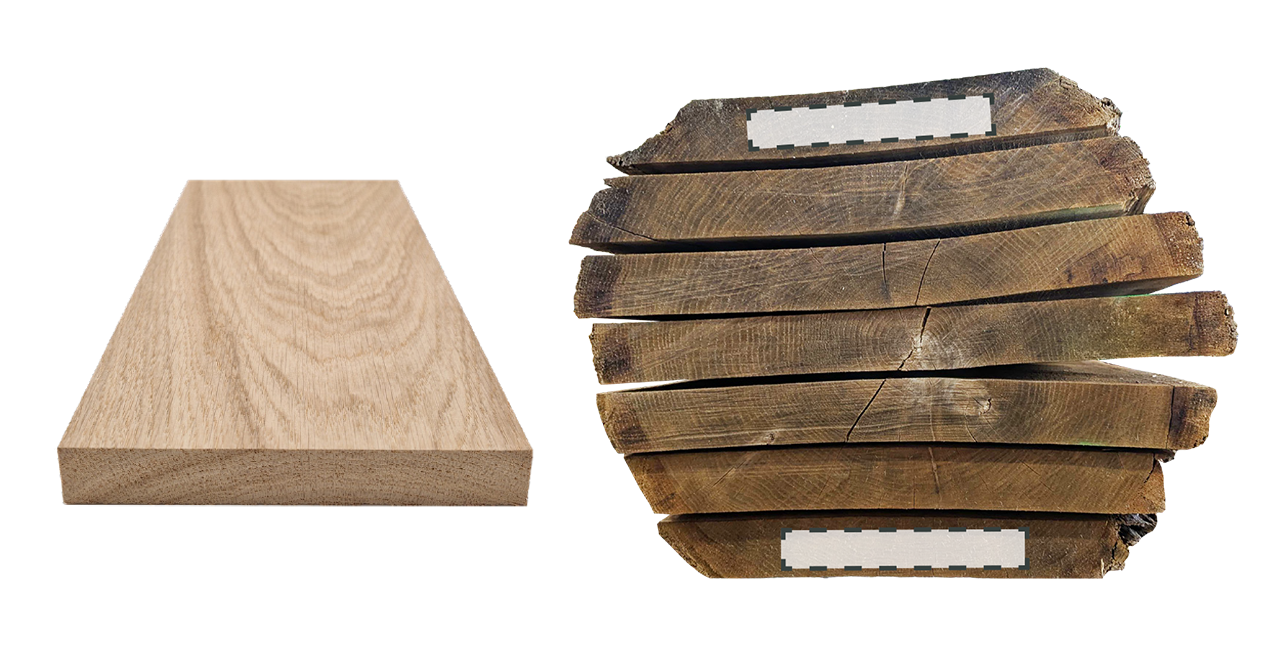
Crown Sawn, also known as Flat Sawn or Plain Sawn, is the most common type of oak board produced by the through-and-through method of log conversion, as it is found at both the top (crown) and bottom of the log. The growth rings are generally about 30 degrees or less to the face of the board, and medullary rays are not seen in this cut, but the boards will have attractive ‘cathedral’ grain features. The widest boards are available in the Crown – Rift section of the log, however these boards are also more prone to cupping and this needs to be considered when looking to use wider sections.
|
What is Quarter Sawn Oak?
Quarter Sawn is the most attractive, durable and stable form of oak available. It is often used for the production of furniture and cabinetry, traditional timber panelling and external and internal joinery.
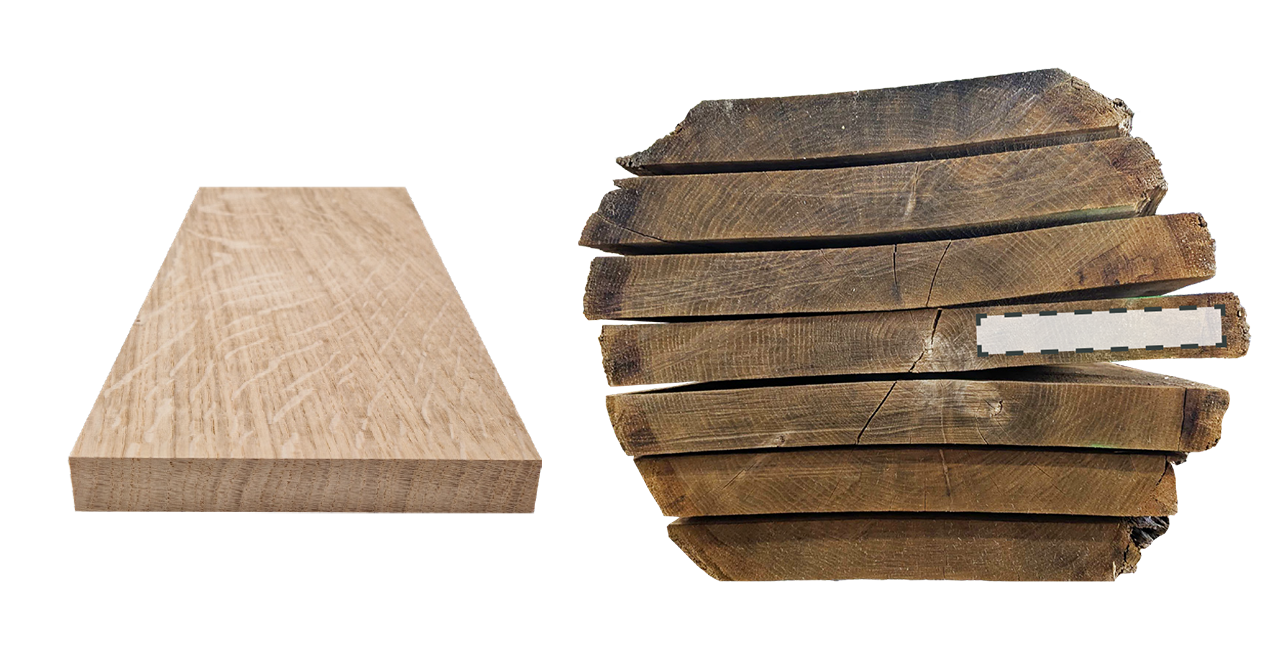
It comes from a method of sawing logs into four quarters at a radial angle, from the outside to the inside. The resulting boards show an exceptionally straight grain pattern, with the growth rings intersecting the face of the board at a 45–90 degree angle. Where the grain pattern allows, the medullary rays can produce distinctive stripes resembling those on a tiger’s hide, hence the name sometimes given to it: ‘Tiger Oak’.
The boards at the very centre of the log produced using the through-and-through method of sawing have the same grain pattern as Quarter Sawn oak. On thinner thicknesses and larger logs, it is normal to include the boards either side of the true Quarter Sawn cuts. As a result, not all Quarter Sawn boards will have the ‘tiger’ effect, but they will have the properties of Quarter Sawn oak.
As well as its desirable grain pattern, Quarter Sawn is the most stable of the three cuts offered, due to the way tangential and radial movement forces interact within the timber. Quarter Sawn oak is also more resistant to moisture penetration and is therefore the most durable of the different cuts.
Every Quarter Sawn board has heart shake running along the middle of the board. This means that very wide boards are not possible in Quarter Sawn oak without laminating narrower pieces together. Avoid specifying Quarter Sawn oak in single planks wider than 200mm as these may not be possible to obtain, particularly in lengths of 3 metres or longer.
|
What is Rift Sawn Oak?
Rift Sawn oak, when produced using the through-and-through method of log conversion, comes from the boards between the Crown (top) of the log and the middle of the log. The Rift Sawn portion of the production has the straightest and most uniform grain pattern of the three different cuts available. The boards have straight grain running along their length on the part nearest the heart or centre of the tree, with medullary rays showing towards the outer edge. These are thinner than those found in Quarter Sawn boards.
The boards nearer the Crown Cut boards produce the widest planks available from an oak log. As boards are selected closer to the centre of the log, they will have heart shake running along their centre. Heart shake is present in every oak tree and sits at the centre of the boards when the through-and-through sawing method is used. Only the oak either side of the heart shake can be used, with the thin ripping containing the heart shake left as waste material.
Rift Sawn oak offers a compromise between the high dimensional stability of Quarter Sawn boards and the clear grain of Crown Cut boards. It is sometimes specified where clear cuttings are required with maximum stability and minimal medullary rays, and is often selected for high-end joinery, cabinetry, furniture and architectural interiors where a calm, uniform grain is preferred.
|
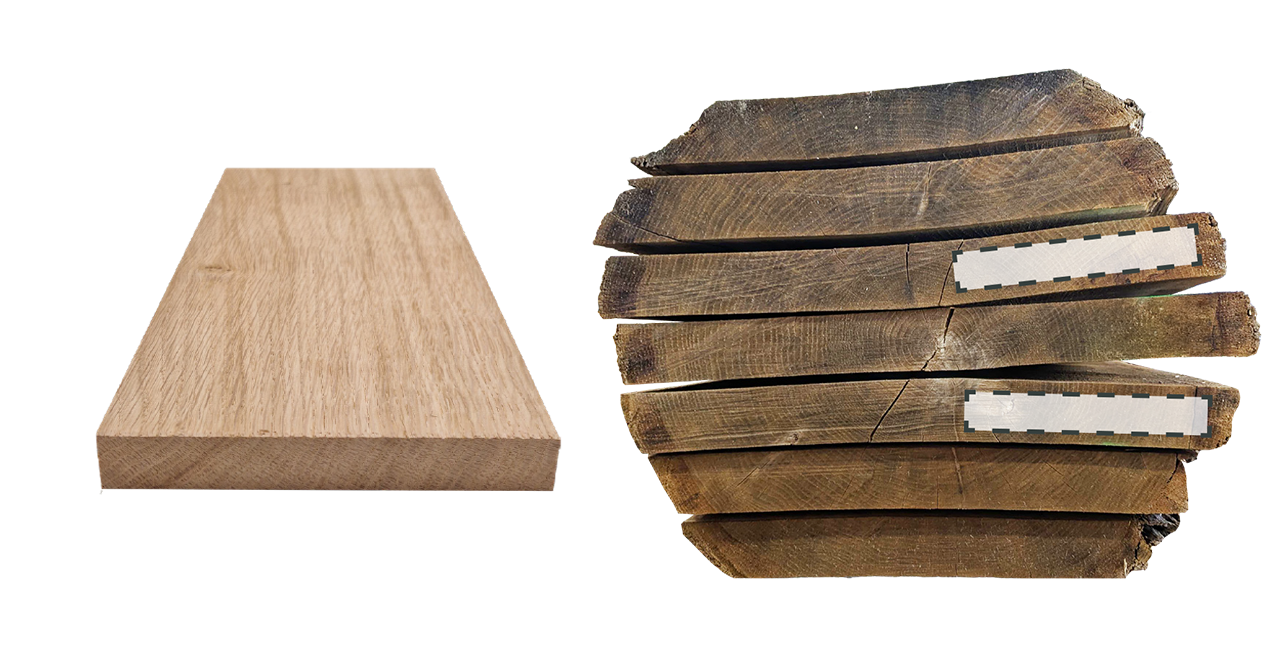
Quarter Sawn and Rift Sawn sound expensive. Can I just use Plain Sawn Oak?
Of course! Unless your finished product demands unrivalled presence, Plain Sawn Oak is the best option for all Joinery applications. Quarter Sawn and Rift Sawn Oak are not materials easily sourced and are often only desired for more elite/high-end projects.


