








Understanding moisture in oak
Learn about the relationship between moisture content and movement in oak.
16th May 2023
Oak is never completely still. Long after it has been felled and sawn, it continues to take up and release moisture in response to its surroundings, and this is what causes it to move. The moisture content of a piece of timber is expressed as the weight of water it contains as a percentage of the weight of the wood when completely dry.
When freshly cut, the heartwood of an oak tree can contain up to 80% moisture, while the sapwood and branches may have even higher levels. The cell walls are fully saturated, and any remaining water is held in the cell cavities.
What happens when a tree is felled?
Upon being felled, the tree’s growth stops, and the trunk begins to lose moisture from its surface. Initially, the “free” water in the cell cavities evaporates until a point is reached where the cell cavities become empty, but the cell walls remain saturated. This moisture level is referred to as the fibre saturation point (FSP), which is approximately 30% for oak but may slightly vary between species.
As the moisture content continues to decrease, the cell walls gradually lose moisture, resulting in a proportional shrinkage across their width. This shrinkage rate, starting from the FSP to complete dryness, is approximately linear. Eventually, under a specific air relative humidity, the moisture content stabilises at a value known as the equilibrium moisture content (EMC).
When does the moisture content stabilise?
In an internally heated environment with a relative humidity of around 40-50%, the moisture content of oak will eventually stabilise at 7-10%. In a protected, unheated environment with a relative humidity of around 60–75%, the EMC will be approximately 12–14%. However, timber exposed directly to sun and rain will naturally experience fluctuating moisture content, ranging from 12% to over 20%, especially in the outer layers that are subject to direct wetting and drying.
This drying process causes the timber to shrink, but the anisotropic (directionally dependent) structure of the wood leads to different effects in three directions. Most wood cells are long and slender and run along the length of the tree, so shrinkage along the grain, from green (freshly cut) to completely dry, is negligible and can be disregarded for practical purposes. For oak, the radial shrinkage (perpendicular to the growth rings) from green to 10% moisture content, partially stabilised by rays, is approximately 4.5%, while the corresponding tangential shrinkage (parallel to the growth rings, with no stabilising cells) is around 7%. These shrinkage movements are notably higher than those observed in most common softwoods.
How does this affect the timber?
The impact of this shrinkage on a specific piece of oak depends on its dimensions and position within the log. To predict distortion accurately, it is helpful to envision the growth rings straightening out as the piece dries, however, the shrinkage will never be uniform in all directions. This non-uniform behaviour is due to the structure of wood and the arrangement of its cells. The two primary directions of interest when discussing wood shrinkage are the tangential and radial directions.
Tangential Shrinkage
- The tangential direction runs parallel to the growth rings, following their curve around the tree.
Oak shrinks most in this direction, around 7% from green to 10% moisture content. Unlike the radial direction, there are no cells running tangentially to restrain this movement. - Tangential shrinkage can lead to the wood developing cracks, splits, and warping. This is because the wood fibers in the tangential direction are interconnected and aligned in a way that promotes greater movement in response to moisture changes.
Radial Shrinkage
- The radial direction runs from the centre of the tree outwards to the bark, crossing the growth rings at right angles.
Radial shrinkage is less pronounced, at around 4.5% for oak. This is because the medullary rays, which are particularly large in oak and give quarter sawn oak its distinctive figure, run radially and help to restrain movement in this direction. - While there is still some dimensional change in the radial direction, it is not as extreme as in the tangential direction.
Why the difference matters
Because oak shrinks almost twice as much tangentially as it does radially, a piece of drying oak does not simply get smaller. It changes shape. This difference between tangential and radial shrinkage is the main cause of cupping, twisting, surface checks and splits as timber dries.
Choosing the right oak for the application
Because oak continues to respond to its surroundings, the key to long-term performance is matching the moisture content of the timber to the environment it will live in. This is why oak is supplied in three forms.
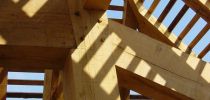
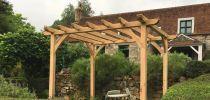
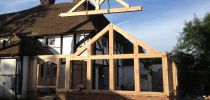
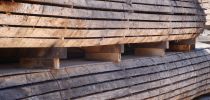
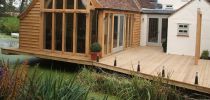
Fresh sawn oak retains its natural moisture and is well above the fibre saturation point when supplied. It will season in situ, shrinking and moving as it dries, so designs must allow for this. It is typically used for structural oak frames, where a degree of natural movement and character is expected and accepted.
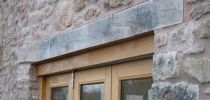
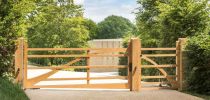
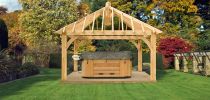
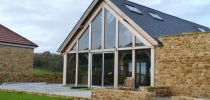
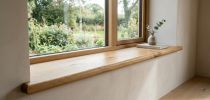
Air dried / Seasoned oak has seasoned slowly outdoors, bringing its moisture content closer to that of the external environment. This makes it the more stable choice for outdoor use, including gates, benches, balustrades, external joinery and glazing trims.
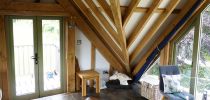
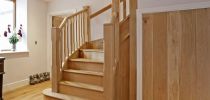
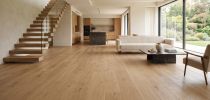
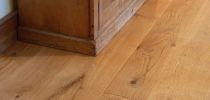
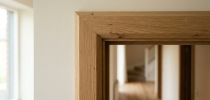
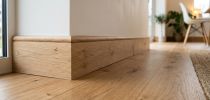
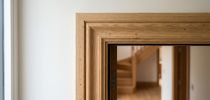
Kiln dried oak has been dried under carefully controlled conditions to the low moisture content needed for stability indoors. In centrally heated or climate-controlled interiors, where oak will settle at around 7–10% moisture content, kiln dried oak is essential for internal joinery, cabinetry, flooring and fitted furniture.
Specifying the right form of oak at the outset, together with good practice in storage, acclimatisation, design and finishing, minimises the effects of moisture-related movement and ensures oak performs well throughout its service life.

